
For the people of Avatime, the Fume–Gbadzeme–Amedzofe–Vane road is far more than a transportation corridor. It represents decades of political promises, repeated assurances, and a development dream that remains unfulfilled.
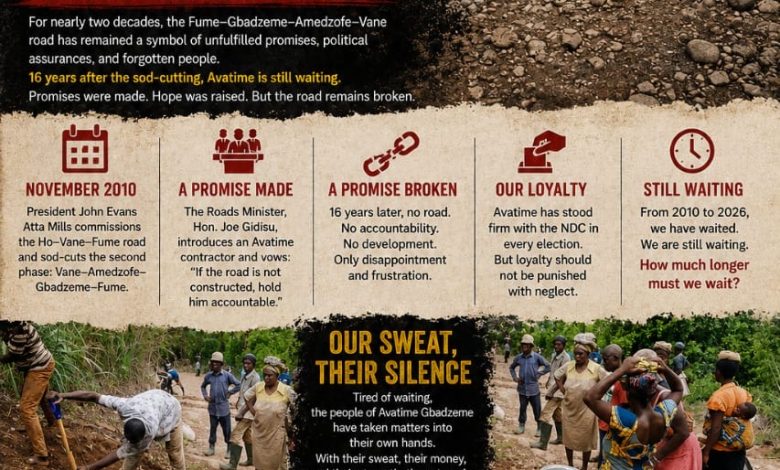
In November 2010, the Avatime Traditional Area became the focus of national attention during the celebration of Amufest. At the time, the late President John Evans Atta Mills visited the Volta Region alongside senior government officials and ministers. During the visit, he commissioned the Ho–Vane–Fume road and performed the sod-cutting ceremony for the second phase of the project, which was expected to extend from Vane through Amedzofe and Gbadzeme to Fume.
The event generated widespread excitement across the traditional area. For many residents, it signalled the beginning of a new chapter—one in which the long-standing challenge of poor road infrastructure would finally be addressed.
Adding to the optimism was a public declaration made on Saturday, 6 November 2010, by the then Minister for Roads and Highways, Hon. Joe Gidisu. Before a large gathering, he introduced a distinguished son of Avatime and respected contractor, announcing that the contract for the road project had been awarded to him. In a memorable moment, the minister reportedly told residents that if the road was not constructed, they should hold the contractor accountable because he was one of their own.
The crowd responded with enthusiasm. Expectations soared. Hope was alive.
Yet the years that followed painted a very different picture.
Sixteen years later, the road remains unconstructed. The grand speeches, official ceremonies, and public assurances have not translated into the development that was promised. What was once presented as a major breakthrough has become, in the eyes of many residents, a painful symbol of neglect and unfulfilled commitments.
The reality is difficult to ignore. Successive governments, both National Democratic Congress (NDC) and New Patriotic Party (NPP) administrations, have failed to deliver on promises made to the people of Avatime. While the details of commitments made under subsequent administrations may be examined separately, the fact remains that the road project has languished for nearly two decades without completion.
What makes the situation particularly painful is the unwavering political loyalty the people of Avatime have shown over the years. Election after election, they have overwhelmingly supported the NDC in both presidential and parliamentary contests, believing that their trust and commitment would be rewarded with meaningful development.
Instead, many residents are increasingly questioning whether that loyalty has become a disadvantage rather than an asset. The old saying that “one’s own pocket knife cuts the deepest” resonates strongly with many who feel abandoned despite their steadfast support.
Perhaps nowhere is this frustration more evident than in the Fume–Gbadzeme section of the road. After years of waiting for government intervention, residents of Avatime Gbadzeme were forced to take matters into their own hands. Through communal labour, men, women, and young people contributed their time, energy, and limited financial resources to make the road passable.
Their efforts reflect both the resilience of the community and the extent of governmental failure. The financial burden has strained already struggling households, while the physical labour has demanded enormous sacrifice. Yet despite these collective efforts, the road remains a significant challenge for commuters, farmers, traders, students, and visitors.
The people of Avatime are not asking for special treatment. They are demanding what has been promised repeatedly for years. They seek fairness, accountability, and the basic infrastructure necessary for economic growth and social development.
The hopes that were ignited during the celebrated visits, speeches, and sod-cutting ceremonies of 2010 have not disappeared. They have simply been deferred for far too long.
Today, one question continues to echo across the hills of Avatime: How much longer must the people wait before the road of broken promises finally becomes the road of progress?